Wednesday, 30 August 2017

Music Advocacy - Music and Your Mood

Just how does music affect our mood? And how can we use music and rhythms to experience a better, more fulfilling life?

Music. It makes us smile; it excites us and makes us dance; it brings us to tears. A simple piece can bring back a memory in full relief; we actually feel we’re there. And it can change our mood within minutes – or instantaneously.

Are you sad, depressed, or anxious maybe? You will be glad to know that you can chase all the blues away just by listening to your favorite music. 

Because of our unique experiences, we develop different musical tastes and preferences. Despite these differences, there are some common responses to music. Babies love lullabies. Maternal singing is particularly soothing, regardless of a mom’s formal musical talents or training. 

Music, Attention & Learning

Everyone who has learned their ABCs knows that it is easier to memorize a list if it is set to music. Scientific research supports common experience that pairing music with rhythm and pitch enhances learning and recall. Music helps children and adolescents with attention problems in several ways. 


Music, Anxiety & Stress

Considered as a natural antidepressant, music can give you the euphoric high that antidepressant medications can bring. So if you are looking for a great way to end your terrible day, read on to learn more about how music can uplift your mood almost instantly.

Music’s beneficial effects on mental health have been known for thousands of years. Ancient philosophers from Plato to Confucius and the kings of Israel sang the praises of music and used it to help soothe stress. Military bands use music to build confidence and courage. Sporting events provide music to rouse enthusiasm. Schoolchildren use music to memorize their ABCs. Shopping malls play music to entice consumers and keep them in the store. Dentists play music to help calm nervous patients. 

Modern research supports conventional wisdom that music benefits mood and confidence. Rhythm and tone can have a definite impact on your happiness – and on your life. Listen to the right set of tones and you can begin to feel the effects more quickly than you’d ever dreamed.


BlueTimbre is a Music Company with Music Education spaces, Jam Room and Recording studio located in Whitefield, Bangalore, India. BlueTimbre provides complete end-to-end Music Education solutions for schools. The BlueTimbre team comes with decades of cumulative experience in running structured businesses, music curriculum development, music education and performance.


Source: 
http://www.healthline.com/health-news/mental-listening-to-music-lifts-or-reinforces-mood-051713
https://www.consciouslifestylemag.com/music-and-the-brain-affects-mood/
https://examinedexistence.com/how-music-changes-your-mood/
http://bestbinauralbeats.org/how-music-affects-our-mood/
https://www.healthychildren.org/English/healthy-living/emotional-wellness/Pages/Music-and-Mood.aspx
http://www.hindustantimes.com/health-and-fitness/here-s-why-music-affects-our-mood-emotions-the-way-it-does/story-QxXKOJYANFGE25X2NBxLrK.html
https://sites.psu.edu/siowfa16/2016/10/02/does-music-affect-our-moods-significantly/

Sunday, 13 August 2017

Guitar Warm Up Exercises

Every professional guitarist starts a session the same way: by warming up.

Whether you’re playing a gig or recital, planning a monstrous practice session, or preparing to impress your friends at home with your killer chops, a precursory limbering up session is mandatory. A thorough warm-up will help bring your playing to peak level and prevent hand injuries

Warm up exercises that can help you to gain fluency, speed and accuracy on the guitar neck. It's a good idea to do some of these exercises every day. Don't do them too long at a time, it's better to exercise regularly (daily) for a short time.

Here are a few methods we recommend to get your hands and fingers warmed up!

You gain the most out of these exercises if you use a metronome. Start slow and built up the speed. Don't force yourself into a tempo that you're not ready for. Make sure your arms and wrists are relaxed. Failing to do so may result in a RSI like tendinitis (wrist inflammation).


Warm Up Exercise

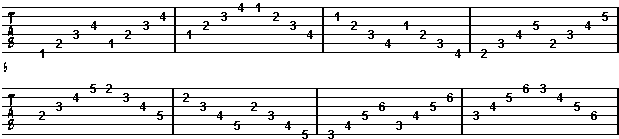
This first exercise helps to develop your fluency, speed and left hand-right hand coordination. Start slow and build up the speed. Use fingers 1, 2, 3 and 4 of your left hand, don't skip the little finger. Use a pick and do alternate picking. The exercise doesn't stop at the end of the tabs, continue for the rest of the neck. Be RELAXED!


The next exercise trains your individual fingers. First do the exercise with fingers 1 and 2. Next round use fingers 2 and 3. Then use fingers 3 and 4. Do the exercise up to the 12th fret and for those of you who can't get enough of it, back from the 12th to the first. And remember: RELAX!


String Skipping Exercises

The following set of exercises train your picking abilities.


This is one of bass player John Patitucci!


The next exercise uses the G major scale. When you reach the last note on the tab, don't stop, but go back.


As you progress, more exercises can be added to this mix. Warm up exercises are very important and not doing them regularly can cause long term damage. Make sure your instructor or Music School is certified and professional. 


BlueTimbre is a Music Company with Music Education spaces, Jam Room and Recording studio located in Whitefield, Bangalore, India. BlueTimbre provides complete end-to-end Music Education solutions for schools. The BlueTimbre team comes with decades of cumulative experience in running structured businesses, music curriculum development, music education and performance.


Source: 
http://www.jazzguitar.be/guitar_technique.html
http://www.guitarplayer.com/lessons/1014/warm-up-time-11-exercises-that-will-help-you-play-even-better/53942

Wednesday, 9 August 2017

Drum Rudiments - Single Stroke Roll

Learn How To Play The Single Stroke Roll Drum Rudiment!

The single stroke roll is the drum rudiment everyone should learn how to play first. If you’ve been playing drums for some time now but have not began learning the 40 drum rudiments, chances are you’ve already applied the single stroke roll to your drum beats and drum fills without knowing about it.
This drum rudiment consists of alternating strokes played between the hands – R (right) L (left) R L R L…or L R L R L R…in case you’re left hand dominant. No matter the hand you start playing it with, it’s important you learn how to execute the single stroke roll leading with both hands.


Don’t rush the process of learning how to play any of the 40 drum rudiments, just so you can get to the drum beats and drum fills. Taking your time with each step of the learning process will actually make you a better drummer. Focus on quality and not on quantity.

As you practice any of the 40 drum rudiments, sit in front of a mirror so you can check your posture, stick heights and even the way each hand plays a stroke of a given rudiment. This is like having a drum teacher watching you play, evaluating your performance and making corrections. When in front of a mirror you’re your own drum teacher. Be demanding with yourself as a teacher would. Try making things sound and look as perfect as possible. Remember to practice with a metronome, have a lot of patience and just keep playing and having fun. With time you’ll become the drummer you aspire to be. You just have to keep at it.

Once you can play the single stroke roll comfortably on a single surface (practice pad, snare drum) you can move on to learn how to apply it to the drum set. On exercise #1, start by playing a 16th note single stroke roll on the hi-hat. Once you have that down, take the leading hand off of the hi-hat to hit the snare drum on counts 2 and 4. Add the bass drum on counts 1 and 3 and you’re set.


On exercise #2, the bass drum pattern is the same as the one on the previous drum beat. However, the 16th note single stroke roll is a lot more broken up between the hi-hat and the snare drum. Keep the weaker hand close to the snare drumhead so you can play very soft ghost notes on the “e’s” and “ahs” of each count. The leading hand is on the hi-hat playing 8th notes on the “ands” and on counts 1 and 3. On counts 2 and 4 move that hand to hit accented strokes on the snare drum.


Exercise #3 is the first drum fill on this 40 drum rudiments free video lesson. The idea for this drum fill is to keep a single stroke roll going around the drums. Start on the snare and move down your toms, playing four strokes per drum.


The last drum fill on this 40 drum rudiments free drum lesson is a variation on the previous one. Instead of starting the drum fill on count 1 of the second bar start it on count 3 – this is known as a half-bar drum fill. Hit the snare drum first and move down your toms, playing two strokes per drum.


Once you’re able to play the single stroke roll and the exercises herein accurately, you can move on to further expand your knowledge of the 40 drum rudiments. If you want to keep studying single stroke based drum rudiments, we encourage you to move on to learn how to play the single stroke four. In case you want to learn a new type of basic rudimentary stroke, then the double stroke roll is the best next thing for you to learn.


BlueTimbre is a Music Company with Music Education spaces, Jam Room and Recording studio located in Whitefield, Bangalore, India. BlueTimbre provides complete end-to-end Music Education solutions for schools. The BlueTimbre team comes with decades of cumulative experience in running structured businesses, music curriculum development, music education and performance.


Source: 

http://www.40drumrudiments.com/single-stroke-roll/

Wednesday, 2 August 2017

How to Sight Sing Efficiently

What Is Sight Singing?

Sight singing is sight reading for singers. When singers sight read, they need to think about three factors at once:

    •      The rhythm
    •      The pitches
    •      The words

Rhythm, Pitches, Words

When you practice sight reading, words are not very important; sing “la la la” if you have to. Pitches, while important, are not as important as the rhythm in sight singing. If you sing the wrong pitches and the right rhythm, you’ll know exactly where you are in the music and be able to catch yourself, even if it sounds bad. If you sing the wrong rhythm, on the other hand, you’re in danger of losing your place in the music and having to stop.

Orient Yourself

Check out the key signature. What key are you in? Is it a major or minor key? How many beats are in each measure? Is there a tempo marking?


Scan

Quickly scan the piece to root out surprises. Is it in mixed meter? Are there tempo changes? Any hidden high notes? This is all helpful information.

Get Your Note

Play the opening chords, or at least your first note, on a piano. The more information you and your ears have, the better.

Tap the Beat

Establish the beat for yourself by tapping it on your leg or collarbone. This will help you stay in rhythm when things get crazy.

Think Solfege

If you know what key you’re in, you should know where the movable ‘do’ is If you know where ‘do’ is, identifying ‘so’ and other key notes becomes easier. Thinking in solfege helps many singers sight read more accurately.


BlueTimbre is a Music Company with Music Education spaces, Jam Room and Recording studio located in Whitefield, Bangalore, India. BlueTimbre provides complete end-to-end Music Education solutions for schools. The BlueTimbre team comes with decades of cumulative experience in running structured businesses, music curriculum development, music education and performance.


Source: 
http://www.jamminwithyou.com/nyc/musicblog/topic/sight-reading

http://takelessons.com/blog/sight-singing-practice-z02

Thursday, 27 July 2017

Loss of Our Favorite Musicians

Be it the recent loss of Chester Bennington of Linkin Park, Chris Cornell of Soundgarden, Leonard Cohen, David Bowie, Paul Kantner of Jefferson Airplane, Chuck Berry, Glen Frey, Prince and so many other legends we grew up listening to - The death of our favorite musicians makes feel a great sense of loss.

What we’re experiencing is the passing of an entire generation of true artists – men and women who worked within the medium of music the way a sculptor works in marble. Can you imagine a world not influenced by the Beatles and Bowie? One without shimmering brass sections, psychedelic guitars and dense keyboard solos? Would anything remain but computer-generated beats and Auto-Tune?  Is there even anyone active in popular music right now who could begin to write the score for a string section? What about a Top 40 band that can approach the sublime harmonies that the unjustly maligned Eagles deliver on “Seven Bridges Road“? Will any rocker ever again reach the rarified air of critical acclaim and universal mainstream appeal that Bowie and the Beatles reached?


This alone provides ample reason to grieve when social media lights up with the tragic news that another pioneer has left us. But I suspect that the death of musical craftsmanship constitutes a small fraction of why we mourn these losses.

Musicians and Fans are connected in an intangible way that a casual listener simply cannot understand. These people we don't know somehow spoke to us directly. The lyrics of our favorite songs take us on a emotional journey that no one can fathom. As David Grohl (Foo Fighters, Ex-Nirvana) once said "That's one of the great things about music. You can sing a song to 85,000 people and they will sing it back for 85,000 different reasons."

While we mourn the loss of a life, we’re also mourning the loss of something inside us. We’ve got to pull the shade down on many happy memories that now sting just a little. And we have to watch the vibrant color these artists brought into our lives drift out of sight like a balloon that slipped from our grasp just a moment before we were ready.


BlueTimbre is a Music Company with Music Education spaces, Jam Room and Recording studio located in Whitefield, Bangalore, India. BlueTimbre provides complete end-to-end Music Education solutions for schools. The BlueTimbre team comes with decades of cumulative experience in running structured businesses, music curriculum development, music education and performance.


Source: 
www.diffuser.fm
personal emotion

Picture Credits: 
http://www.vam.ac.uk/content/articles/t/touring-exhibition-david-bowie-is/
http://www.billboard.com

Tuesday, 18 July 2017

Heel Up and Heel Down Techniques

This is an article that gives clarity on the most common foot techniques used while playing the drums - these are the Heel Up & the Heel Down techniques.


Different tools for different jobs

An important concept to grasp from the outset is that these foot positions are used to achieve different things.

  • Heel-down technique is used to play at low to medium volumes.
  • Heel-up technique is used for medium to loud volumes and for accessing multiple stroke techniques.


Heel-down foot technique is ideal for playing at low to medium volumes. The stroke is a result of the calve muscle engaging a flexion at the ankle joint. Make sure you keep your foot in contact with the foot board throughout the motion. Remember that this technique is not for playing loud.


Heel-up technique engages the weight of the entire leg to facilitate the stroke. It uses ankle and hip flexion in the movement and works best with the heels only a few inches off the floor. 

This technique also allows you to access multiple stroke technique such as the step-slide technique and the heel-toe technique. Good foot technique often facilitates improve balance and centering and can dramatically improve your groove playing. 


Work on exercises to improve foot technique in both heel-down and heel-up positions. Remember the limitations of each position and don’t waste your practice time trying to make one position do things it will be able to do.


BlueTimbre is a Music Company with Music Education spaces, Jam Room and Recording studio located in India. BlueTimbre provides complete end-to-end Music Education solutions for schools. The BlueTimbre team comes with decades of cumulative experience in running structured businesses, music curriculum development, music education and performance.


Source: 
http://theparadiddler.com/2010/01/26/dvd-review-unburying-the-beater/
http://www.drum-mastery.eu/dms/drum-mastery/documents/shure-drum-mastery-paper-foot-techniques/shure-drum-mastery-paper-foot-techniques.pdf

Wednesday, 12 July 2017

How to Sing Efficiently

All of us have a singing voice, but not everyone has developed proper vocal techniques in order to be sure where to find or how to use that voice. Not convinced? Head out to a Karaoke Bar one evening. Chances are you’ll witness a variety of passionate singers out there. All of them showing their confidence and courage to express themselves publicly.

But let’s be honest, some are less pleasing to the ear than others, and we love them anyways! The point is, that there are also many naturally good singers as well. Even these with proper training could very easily, not only raise their level, but also reduce the amount of effort involved in sounding great. So here are 3 points that we know will help you sing more efficiently.


#1 Posture

Perhaps there’s another secret as to why your mother constantly reminded you to stand up straight. The truth is..it makes you a better singer. How? It’s vitally important to align your body parts and prepare them to support your sound, while eliminating tension. Tension not only makes you feel uncomfortable and affects your mood, but can greatly restrict air flow, making singing a chore rather than pure enjoyment.

Exercise: Find a wall and stand with your back to it. Place your head to the wall so that your chin is parallel to the floor. Open your shoulders and roll them back to the wall. Without allowing your spine to touch, slowly move your back towards the wall to straighten. Arms to your sides. Feet shoulder width apart, find your balance. Try to relax. The only tension you create should be in your abdominal muscles that are supporting your singing. It is more effective if you do this in front of a mirror. This can especially help you to visualize your stance after you see and feel proper posture.


#2 Breathing

Try holding your breath and singing or even speaking. You get the point right? Clearly, air is a major component to singing. When singing a melody, the words are expressed quite differently than if you were to simply recite the sentences aloud. The volume, the pitch, the tone and the tempo can have you gasping for air before you know it.

Learning and mastering proper breathing is one of the keys to instantly improving your ability to sing. Unless we are exercising, normally our breathing is quite shallow. As we begin training our body to sing, we need to take deeper breaths in order to sustain our sound loud and clear for our listening audience. At first you may even feel a rush of dizziness as the deeper you breath, the more oxygen that gets to your brain. But don’t stress it! Your body just needs to get used to proper and more efficient breathing.


#3 Healthy Habits

Simple healthy habits can often be the most beneficial for your vocal health. It doesn’t matter if you meet a heavy metal singer, pop singer, or an opera singer. You can bet any one of these true professionals can appreciate the abundance of good ole H2O. It’ll always be within arms reach whether they are in the studio, rehearsal, or on stage. Some prefer drinking warm water, claiming that it better refreshes your throat. Others swear that ice cold water can aid in keeping swelling down, especially after a killer belting performance. Regardless of your preference. Just drink lots of it! 

Avoid dairy products, oily foods and extremely cold items for at least three days before a gig/show to keep your voice in the best shape. 

Keep these three points in mind for a healthy and efficient singing experience. 


BlueTimbre is a Music Company with Music Education spaces, Jam Room and Recording studio located in India. BlueTimbre provides complete end-to-end Music Education solutions for schools. The BlueTimbre team comes with decades of cumulative experience in running structured businesses, music curriculum development, music education and performance.


Source: 
https://prezi.com/tfviibc1tdqr/how-to-sing-efficiently/
https://www.vocaltips.net/vocal-techniques-for-beginners/
https://singersedge.com/singers-voice-training-crucial-for-success/